
Everywhere you look, people are proclaiming the death of Google. With the rise of AI tools like ChatGPT, Claude, Perplexity, and generative search engines, many are asking:
“Is Google still the gateway to the world’s knowledge?”
The short answer?
No, Google is not dying — but it’s under serious threat like never before.
Let’s break down what’s really happening.
Why Everyone Thinks “Google Is Dying”
1. Search Is Changing
Users are getting instant, summarized answers from AI chatbots. Instead of sifting through 10 links, people just ask ChatGPT and move on. The habit is shifting — and fast.
2. Traffic Is Dropping
Website owners, bloggers, even YouTubers are seeing major organic traffic drops. Why? Because LLMs summarize content without needing users to click. This undercuts Google’s ad-driven model.
3. Search Results Feel Broken
Many search results are stuffed with SEO junk, endless ads, and affiliate content. Trust in Google’s results is eroding — especially for nuanced or niche queries.
4. Younger Users Are Searching Elsewhere
Gen Z doesn’t default to Google. They search on TikTok, YouTube, Reddit, or even ChatGPT when they want opinions, trends, or how-tos.
Why Google Isn’t Dead (Yet)
Despite the noise, Google still holds massive power — and isn’t going down without a fight.
1. It’s Still the Default Everywhere
Google Search is baked into Chrome, Android, Gmail, and Google Maps. Billions still use it every day by default.
2. Data Advantage
Google has two decades of global search data, map intelligence, shopping trends, and user behavior. That’s hard for anyone to replicate overnight.
3. They Own the Internet’s Infrastructure
From YouTube to Google Docs, Android to Gmail, Google still owns platforms people rely on every single day.
4. They’re Not New to AI
Let’s not forget: Google owns DeepMind and is investing heavily in Gemini, their next-gen AI model. They may have been late to launch, but they’re definitely not out of the game.
The Real Risk: Losing Search Dominance
Here’s the catch:
Google doesn’t need to die to lose everything — it just needs to lose control of how we access information.
If people begin to rely on AI assistants, chat interfaces, or embedded AI in apps instead of typing into a Google box, the search ads business model breaks.
Apple, OpenAI, Perplexity, or even TikTok could become the new front doors to information, purchases, and decisions.
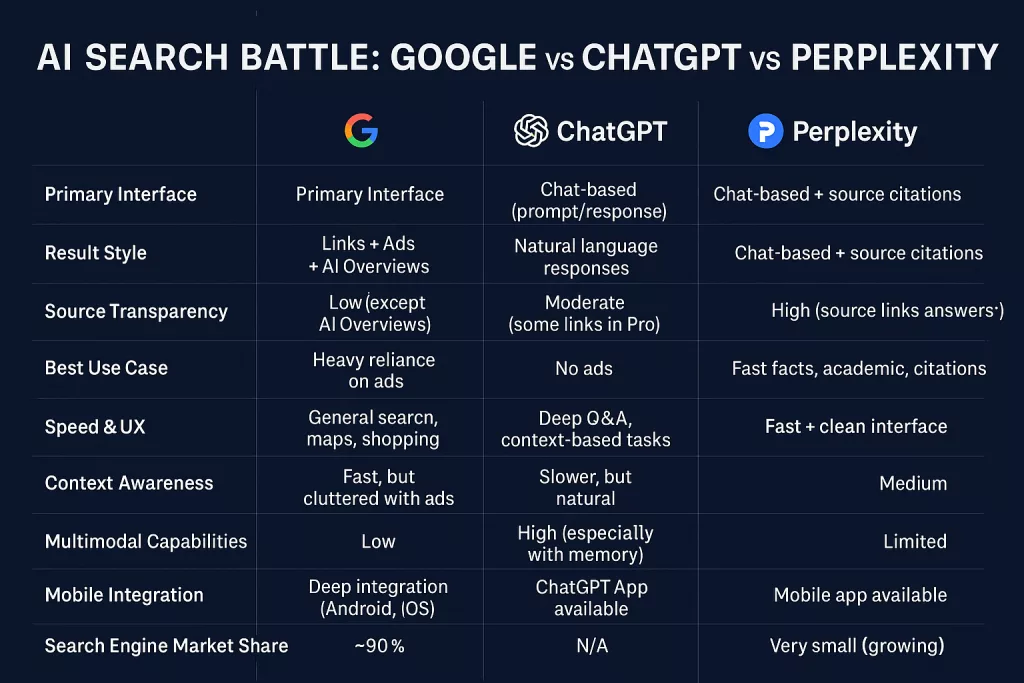
🔍 AI Search Battle: Google vs ChatGPT vs Perplexity
| Feature/Category | ChatGPT (w/ Browse) | Perplexity AI | |
|---|---|---|---|
| Primary Interface | Search box + links | Chat-based (prompt/response) | Chat-based + source citations |
| Result Style | Links + Ads + AI Overviews | Natural language responses | Summary + Sources |
| Source Transparency | Low (except AI Overviews) | Moderate (some links in Pro) | High (source links in answers) |
| Ads & Monetization | Heavy reliance on ads | No ads | No ads (as of now) |
| Best Use Case | General search, maps, shopping | Deep Q&A, context-based tasks | Fast facts, academic, citations |
| Speed & UX | Fast, but cluttered with ads | Slower, but natural | Fast + clean interface |
| Context Awareness | Low | High (especially with memory) | Medium |
| Multimodal Capabilities | Partial (Gemini in labs) | Strong (images, code, docs) | Limited |
| Mobile Integration | Deep integration (Android, iOS) | ChatGPT App available | Mobile app available |
| Search Engine Market Share | ~90% (dominant) | N/A | Very small (growing) |
What the Future Looks Like
We’re entering a post-search era, and Google knows it.
- AI-Generated Summaries are already appearing in “AI Overviews.”
- Chat-based browsing will soon be the norm.
- Personal AI agents may take over your emails, documents, calendar, and even your web browsing.
- Vertical search engines (Reddit for discussions, TikTok for trends, Amazon for shopping) are already stealing attention.
The question isn’t just “Can Google compete?” — it’s “Can Google redefine itself fast enough?”
Final Thought: The Fight Isn’t Over
Google isn’t dead. But it’s in the middle of the biggest reinvention in its history.
The tech giant that once replaced libraries and directories is now being replaced by intelligent assistants.
The future belongs to whoever builds the best interface between humans and knowledge — and for the first time in 20 years, that winner might not be Google.